Three questions before the second sitting, and the reading budget they protect
A walkthrough on a topic the reader already understands can be the most expensive piece of editorial in a guides library, and the cost never shows on the invoice. The reader finishes the first pass knowing the rule and the example. The reader starts the second pass looking for the trade-off the first pass skipped. The second pass either finds the trade-off, in which case the ten minutes were the best ten minutes the reader spent all week, or it does not, in which case the reader has spent ten minutes re-reading a book the reader has already read.
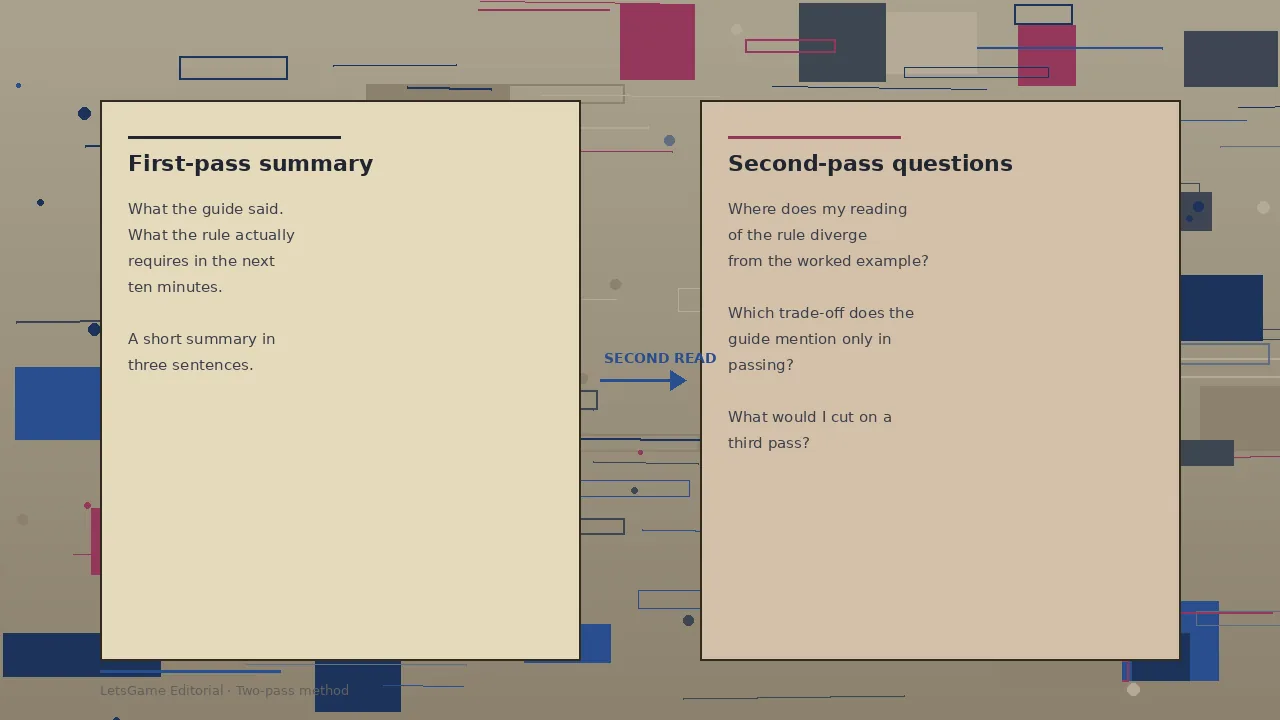
The two-pass method below treats the second read as a decision the reader makes after the first sitting, not a habit the reader keeps by default. Three questions decide the decision, all of them written down before the second ten minutes start. LetsGame editors run this method on every walkthrough that survives the first scroll, because the cost of finishing a second pass the reader did not need is not the ten minutes spent. The cost is the next walkthrough the reader did not have time for.
Nothing here claims a current event, live offer, current contest, named scorer or named brand partnership. The method is built from the structural parts of any walkthrough the reader has already finished: a summary the reader wrote on the back of an envelope, a margin note the reader did not draw on the first pass, and a checklist the reader has not yet stress-tested. The exact words the reader wrote are not specified. The three questions are.
Question one: did the first pass leave a margin note the reader did not write down
The first question is whether the first pass left an unanswered note the reader can name. A walkthrough that left no margin note is a walkthrough the reader has fully digested. A walkthrough that left a margin note the reader can write down on a single line is a walkthrough with a second pass waiting to be taken. The margin note the first pass did not write down is the test, and the test is one sentence long: a margin note is a sentence the reader almost wrote, then chose not to, because the walkthrough had not yet earned the cost of writing it.
The reason the margin-note test is the cheapest of the three is that the reader can run it on the walk back from the desk. The reader who finishes the first pass, walks to the kitchen, and finds no margin note waiting in the mind has finished the walkthrough. The reader who finishes the first pass, walks to the kitchen, and finds a single sentence waiting for the second pass has not yet finished. The second pass earns its time when the sentence can be written in under thirty seconds. The second pass loses its time when the sentence has to be hunted down with the walkthrough open on the second screen.
Scenario test: a reader who finished a captain-choice walkthrough last week, wrote down the toss rule, and now wonders whether the same walkthrough applies to a five-over variant. Margin note A is "does the captain choice still double if the player is dropped at the end of the fifth over?" Margin note B is "the captain choice was the easiest part." Margin note A is a question the second pass can answer. Margin note B is a sentence the first pass already finished. The reader who picks Margin note A opens the walkthrough for a second ten minutes and walks away knowing the answer. The reader who picks Margin note B opens the walkthrough out of habit and walks away with nothing the first pass did not already give.
Question two: does the second pass change a number the first pass wrote down
The second question is whether the second pass would change a number the first pass committed to paper. A walkthrough that survives the second pass unchanged is a walkthrough the reader has fully mapped. A walkthrough whose second pass changes a number is a walkthrough with a second decision waiting. The number the first pass wrote down is the test, and the test is one paragraph long: a number is a specific value the reader wrote next to a specific rule, on the assumption the value would survive a second read. A number that survives the second read is a habit. A number that does not survive is a re-read that earned its time.
The reason the number test is the second cheapest is that the reader can run it against the margin notes from the first pass. The reader who finds no number the first pass committed to has nothing to stress-test. The reader who finds a single number the first pass committed to, and who can predict what the second pass would change, has a second pass that will pay for itself before the second ten minutes end. A second pass that fails the number test is a second pass the reader could have skipped, and the skipped minutes are the next walkthrough the reader now has time for.
Scenario test: a reader who wrote down "captain multiplies by 2.0" after the first pass, and who now reads a marginal note about an optional vice-captain multiplier that takes effect if the captain is dropped mid-match. Number A would change from "2.0" to "2.0 with a 1.5 fallback the reader never saw." Number B would stay at "2.0" because the reader has already seen the fallback and decided not to use it. Number A is a re-read that pays for itself. Number B is a re-read the reader has already done in passing, on the first pass, and the second pass would only confirm a decision the first pass already made.
Question three: does the walkthrough have a checklist the reader has not yet stress-tested
The third question is whether the walkthrough closes with a checklist the reader has not yet run against a real session. A checklist the reader has run once is a checklist the reader has finished. A checklist the reader has not yet run is a checklist with a second pass waiting. The untested checklist is the test, and the test is one paragraph long: an untested checklist is a list of actions the walkthrough told the reader to take, on the assumption the reader would take them in the next ten minutes. A list the reader has taken is a list the second pass cannot improve. A list the reader has not yet taken is a list the second pass can sharpen, shorten, or quietly drop.
The reason the checklist test is the most concrete of the three is that the reader can answer it without re-opening the walkthrough. The reader who has run every action on the checklist in the last session has finished the walkthrough. The reader who has run one action and skipped three has a second pass waiting, and the second pass will be the difference between a checklist the reader runs and a checklist the reader skips. A second pass that fails the checklist test is a second pass the reader could have spent on a different walkthrough, and the spent minutes are the cost the two-pass method is built to prevent.
Scenario test: a reader who finished a captain-choice walkthrough and wrote down a four-action checklist: confirm the toss, pick the captain, lock the lineup, set the vice-captain. The reader has run the first action and skipped the rest. The second pass would sharpen the checklist by reordering the third and fourth actions, and would add a single follow-up the first pass never named. The walkthrough has a checklist the reader has not stress-tested. The second pass earns its ten minutes. The reader who picks up the walkthrough and finds a checklist the reader has already run end-to-end has a different kind of second pass waiting: a re-read the first pass already gave them, and a set of minutes the reader can save for the next walkthrough that needs them.
What the second pass costs when the three questions all say no
The three questions all say no when the first pass left no margin note, when no number the first pass wrote down would change, and when the checklist the walkthrough closes with has been run end-to-end. The reader who treats the three "no"s as a binding answer closes the walkthrough and moves to the next piece. The reader who treats the three "no"s as a soft signal and finishes the second pass anyway has paid the ten minutes the second pass was not worth, and has lost the ten minutes the next walkthrough was worth. LetsGame editors treat the three "no"s as binding, because the cost of finishing a second pass the reader did not need is not the time spent on it. The cost is the next walkthrough the reader never opens.
The three questions all say yes when the first pass left a margin note the reader can name, when a number the first pass wrote down would change under the second pass, and when the walkthrough closes with a checklist the reader has not yet run end-to-end. The reader who treats the three "yes" answers as a binding signal reads the walkthrough again with a smaller budget and a closer eye. A binding "yes" still allows the reader to walk away at the second question, the third question or the fourth. The two-pass method is not a contract. The two-pass method is a budget audit the reader runs again whenever the walkthrough returns a surprise.
The third pass, and the walkthroughs that repay a third sitting but not a second
A walkthrough that survives the second pass is not always worth a third. The third pass runs the same three questions against the second pass: did the second pass leave a margin note the reader did not write down, did a number the second pass wrote down change under the third pass, and does the second pass close with an action the reader has not yet run. A walkthrough that survives three passes is worth printing. LetsGame editors run the three questions three times before they commit a walkthrough to print, because the cost of printing a walkthrough that cannot survive a third pass is the cost of carrying a bad notebook to the next session.
The third pass is also the place the reader catches the walkthroughs that survived the second pass on style and failed on substance. A walkthrough can survive the margin-note test, the number test and the checklist test, and still fail the action test on the third pass. The action test is the same three questions in a smaller form. The margin note names a sentence the reader almost wrote. The number names a value the reader committed to paper. The checklist names an action the reader has not yet run. A walkthrough that fails the third pass costs the reader another ten minutes, and another ten minutes is the next walkthrough the reader does not have time for.
When the three questions disagree, and the question that wins the disagreement
The three questions disagree when one says yes and two say no. The disagreement is more common than the clean pass, because most walkthroughs on a topic the reader already knows will leave a single margin note, change no number, and close with a checklist the reader has partly run. A walkthrough with a margin note, an unchanged number and a half-run checklist is a walkthrough where the reader found one new question and zero new answers. A walkthrough with no margin note, a changed number and a half-run checklist is a walkthrough where the reader found no new question and one new answer.
The question that wins the disagreement is the checklist question. The checklist is the longest test the reader runs in writing, and the test the reader will have to act on regardless of which two questions failed. A walkthrough with an untested checklist is a walkthrough the reader can act on without trusting the margin note or the number. A walkthrough with a fully-run checklist is a walkthrough the reader has to act on by trusting the margin note or the number alone. LetsGame editors treat the checklist question as the tie-breaker because the checklist is the part of the walkthrough the reader will spend the next ten minutes executing.
Applying the two-pass method to a walkthrough the reader has already half-finished
The two-pass method is also useful on walkthroughs the reader has already half-finished. The reader who has spent five minutes on the second pass and is not sure whether to spend the next five can walk away from the keyboard and run the three questions in writing. The method takes under a minute, and the result is binding the same way the first run was binding. A walkthrough that fails the three questions on the re-run was failing the three questions on the first run. The five minutes the reader spent on the second pass are not recoverable. The next five minutes are still budgeted.
The re-run is also a way to catch the walkthroughs that pass the three questions on the first run and fail on the second. The reader who has run the three questions once and is not sure whether to keep going can run them a second time. The second pass on the three questions is the same test in a smaller form. A walkthrough that fails the second run of the three questions is a walkthrough the reader should walk away from, even though the first run of the three questions was promising. The cost of walking away is the next ten minutes the reader has not yet spent. The cost of staying is the next ten minutes the reader will spend on a walkthrough that cannot answer the question the reader opened it with.
Keeping the two-pass method small enough to run on a single sitting
The method is short on purpose. A reader who treats the three questions as a long checklist will spend the first minute building the checklist instead of running it, and the budget the method was supposed to protect will already be spent. LetsGame editors keep the method to three questions, in three minutes, with one answer each. A reader who wants to extend the method can add a fourth question, but the fourth question has to be one the reader can answer in writing. A fourth question the reader has to re-open the walkthrough to answer is a fourth question the reader will not run on a single sitting, and the method will fail for the same reason the walkthroughs it screens fail.
The practical use of the method is the moment a reader finishes a walkthrough and decides whether to commit a second sitting. The reader writes down three answers in under a minute, makes the call, and moves on. The reader who treats the method as a habit will save the next walkthrough the method would have cost them, and the next walkthrough is the one worth carrying into the next session. LetsGame editors treat the two-pass method as the cheapest way to keep reading time for the walkthroughs that earn it, and as the cheapest way to walk away from the walkthroughs that do not.
Readers who want to keep their reading budget for the walkthroughs that earn a second sitting can move from this method into the wider guides library at LetsGame guides, where the long-form walkthroughs are listed in the order LetsGame editors would read them if they had to triage a fresh library in a single sitting.
